
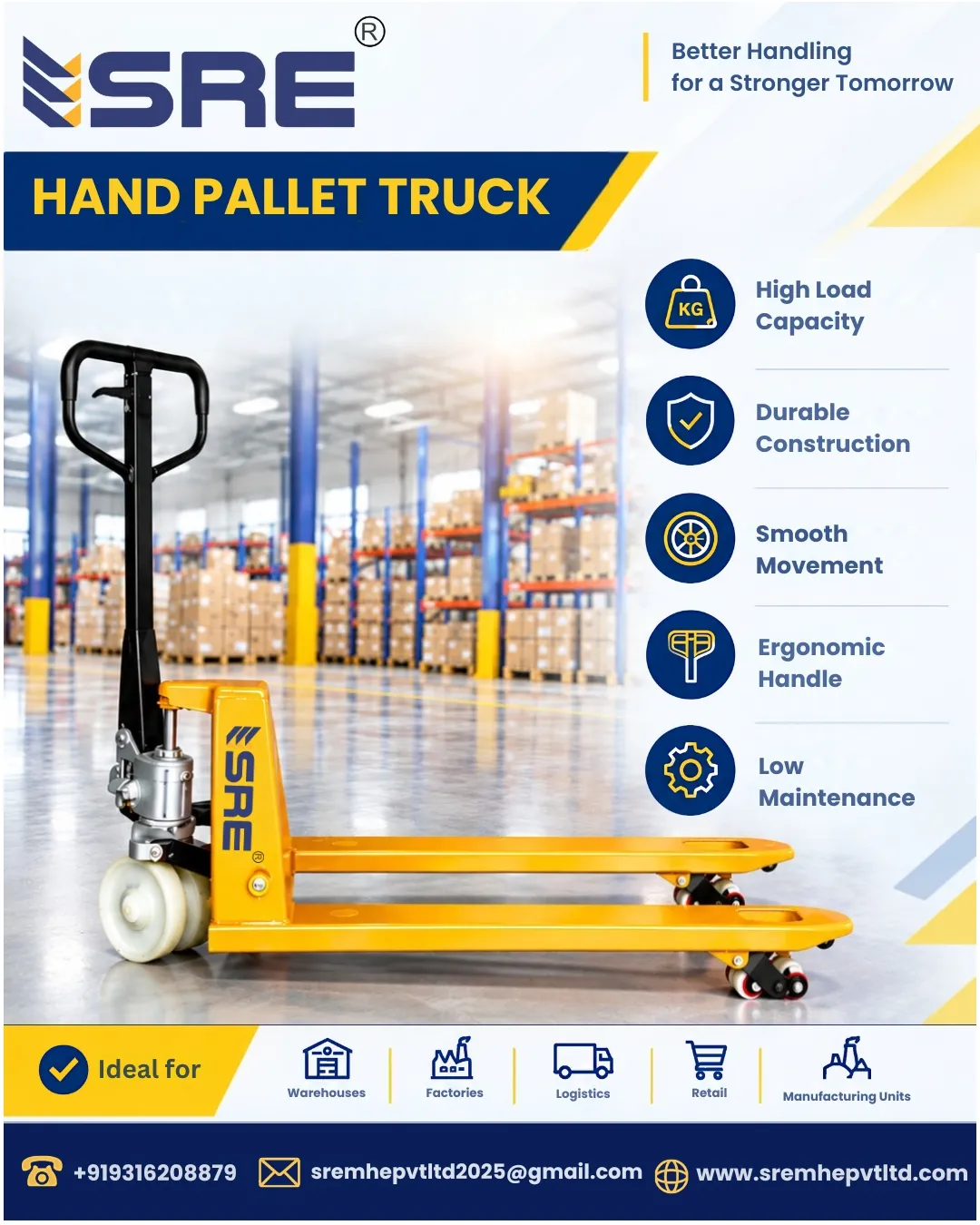
Hand Pallet Truck Guide 2026: 7 Proven Reasons It’s the Best Buy for Your Warehouse
A hand pallet truck is probably the single most-used piece of equipment on any Indian shop floor, and yet it’s the one most businesses know the least about. Ask five warehouse managers what separates a good unit from a bad one, and you’ll get five different (often wrong) answers — “heavier is better,” “cheaper is fine for occasional use,” “all hydraulics are the same.” None of that is true, and getting it wrong means cracked pallets, injured staff, and equipment that’s dead in six months instead of six years.
This guide covers what a hand pallet truck is, how it works, which type fits your operation, and how to read a specification sheet like someone who’s bought a few hundred of them — drawing on real manufacturing data from SRE Material Handling Equipment Private Limited (formerly Shree Ram Enterprise), an Ahmedabad-based, ISO 9001:2015-certified manufacturer building this equipment since 2011.
What Is a Hand Pallet Truck?
A hand pallet truck — also called a pallet jack, manual pallet truck, or manual pallet truck — is a manually operated device with two steel forks that slide under a loaded pallet, lift it a few inches off the ground using a hydraulic pump, and let one person roll it across a floor. There’s no engine or battery, and almost nothing that can go wrong if it’s built correctly, which is why it remains the backbone of Indian warehouses, factories, cold stores, and retail backrooms, even where forklifts and electric stackers are also in use.
At its core, the unit is simple: a chassis, two load-bearing forks, a hydraulic pump, a steering tiller, and wheels. The real engineering lies in how those parts are built — thin, poorly welded steel flexes and leaks under repeated loading, while a frame built to the right specification runs for a decade with almost no maintenance.
How Does a Hand Pallet Truck Work?
A hydraulic hand pallet truck works on the same principle as a hydraulic car jack. Pumping the tiller handle forces oil into a sealed cylinder, and that pressure raises the forks — and the pallet resting on them — by roughly 85–200 mm. Once the load clears the ground, rotating the tiller fully in one direction releases a valve that lowers the forks smoothly, without ever dropping the load.
Moving it is just as simple: with the tiller angled midway, the wheels roll freely, and steering happens by swinging the tiller left or right, much like a shopping trolley built to carry a couple of tonnes instead of a few kilos. Load wheels (under the forks) and steering wheels (under the chassis) are usually polyurethane or nylon, chosen based on whether the floor is smooth epoxy, rough concrete, or a cold-storage surface.
Types of Hand Pallet Trucks
Not every unit looks or performs the same. The main variants used across Indian industry:
- Standard — the everyday workhorse, rated 2,000–3,000 kg, with 1,150 mm forks for standard pallets.
- Long-Fork / Double Pallet Truck — forks up to 2,000 mm, moving two pallets side by side, common in FMCG and textile warehouses.
- Stainless Steel — corrosion-resistant, washdown-safe units for pharma, dairy, and food plants.
- Weighing Pallet Truck — built-in load cell and digital indicator, so goods are weighed the moment they’re lifted.
- Reel/Drum Handling — a specialised fork profile that cradles cable reels, paper rolls, or drums instead of flat pallets.
- High-Lift — raises loads to an 800–1,000 mm working height, turning the truck into a mobile workbench.
- Semi-Electric / Battery-Operated — lifting, driving, or both are powered, cutting operator fatigue on high-frequency routes.
Key Features and Benefits
A well-engineered pallet truck earns its place on the floor for reasons beyond price:
- Cost-effective for short hauls. For moves under 50–100 metres, nothing beats the running cost of a manual unit — zero fuel, zero charging downtime.
- Frame strength that survives daily abuse. Quality frames use thick, jig-welded M.S. sheet — commonly 5 mm for 3-tonne capacity and 3.15 mm for 2-tonne — resisting the twisting loads thinner, mass-produced frames can’t take.
- Smooth, controlled lowering that protects both the goods and the operator’s feet.
- Manoeuvrability in tight aisles where bulkier electric equipment won’t fit.
- Near-zero downtime, with nothing to service beyond hydraulic oil top-ups and wheel checks.
- Minimal training needs, since manual units fall outside powered-equipment operator certification requirements.
Hand Pallet Truck Specifications
| Parameter | Typical Range | Notes |
|---|---|---|
| Load Capacity | 800 kg – 5,000 kg | Higher capacities need reinforced 5 mm frames |
| Fork Length | 1,150 mm (standard) – 2,000 mm (long fork) | Match to your pallet size |
| Fork Width | 520 mm – 685 mm | Wider forks suit export/Euro pallets |
| Lift Height | 85 mm – 200 mm | Standard hydraulic lift range |
| High-Lift Height | 800 mm – 1,000 mm | For picking/assembly-style trucks |
| Frame Material | M.S. Sheet, 3.15 mm (2T) / 5 mm (3T) | Jig-welded, heavy-duty formed steel |
| Wheel Material | Polyurethane / Nylon / Rubber | Chosen per floor type and load |
| Variants | Standard, Long-Fork, Stainless Steel, Weighing, Reel-Handling, High-Lift, Semi-Electric, Battery | Application-specific |
| Certification | ISO 9001:2015 (manufacturer level) | Confirms quality management system |
Hand Pallet Truck vs Pallet Jack
Many buyers search these as if they’re different products. In Indian and international usage, they’re almost always the same equipment — the table below clears up where real distinctions exist.
| Aspect | Hand Pallet Truck | “Pallet Jack” (Term Usage) |
|---|---|---|
| Meaning | Formal/technical name, common in India & Europe | Colloquial term, more common in the US |
| Power Source | Manual hydraulic pump | Can mean manual or electric versions |
| Typical Buyer | Manufacturers, warehouses, logistics firms | Same audience, different regional wording |
| Regulatory Status | Not a powered industrial truck | Powered versions face stricter training rules |
| Price Range (India) | Lower for standard manual units | Similar for manual; higher for electric versions |
In short: every hand pallet truck can correctly be called a pallet jack, but not every “pallet jack” — especially a powered one — is this simple, manual category.
How to Choose the Right Hand Pallet Truck
Buying the wrong unit is a common, expensive mistake. Work through these checks first:
- Match capacity to your heaviest pallet, plus a margin. A load at the edge of a truck’s rating deserves the next size up.
- Check fork dimensions against your actual pallets, not an assumed industry standard — sizes vary widely between industries in India.
- Ask about frame thickness, not just the capacity rating. Two “2-tonne” trucks can differ hugely in real-world durability depending on whether the frame is 3.15 mm or thinner sheet.
- Consider your flooring — rubber or nylon wheels for rough concrete, polyurethane for smooth epoxy.
- Factor in environment. Cold storage or washdown areas call for a stainless steel unit over painted steel.
- Buy from a manufacturer, not just a trader, who can support spares, servicing, and custom fork lengths for years afterward.
As a reference point for what a well-specified range looks like: Ahmedabad-based manufacturer SRE Material Handling Equipment offers a hand pallet truck range spanning 800 kg to 5,000 kg capacities, standard 1,150 mm forks through to 2,000 mm long-fork models, stainless steel trucks for washdown areas, an integrated-weighing model, a reel/drum-handling model, and high-lift trucks reaching 800–1,000 mm working height — built on jig-welded M.S. frames (5 mm for 3-tonne, 3.15 mm for 2-tonne capacity), which is the kind of specification detail worth asking any supplier for.
Applications, Safety and Maintenance
Where these trucks are used Warehouses and 3PL hubs, FMCG and textile distribution centres, pharmaceutical and dairy plants (usually the stainless steel variant), auto-component and engineering factories, retail backrooms, and loading docks needing a fast unload without waiting for a forklift.
Safety practices that matter Even though a manual unit isn’t classed as a powered industrial truck, misuse still causes crushed toes, strained backs, and tipped loads. Good practice: inspect wheels and the hydraulic pump before each shift, never exceed rated capacity, keep feet clear of the forks while lowering, and push rather than pull for better control. The U.S. Occupational Safety and Health Administration’s Powered Industrial Trucks standard (29 CFR 1910.178) sets out design, maintenance, and safe-use requirements for material handling equipment generally — and while it specifically governs powered units, the same discipline of pre-use inspection and controlled operation applies just as well here. Read the full standard on the official OSHA website.
Maintenance that extends service life Wipe down forks and chassis to keep grit out of the wheel bearings, check hydraulic fluid every few months, grease the tiller and lifting-mechanism pivots, and replace worn wheels before they damage flooring. Built on a proper jig-welded frame, a well-maintained unit routinely outlasts a decade of single-shift use.
Why Choose Us for Material Handling
SRE Material Handling Equipment Private Limited (formerly Shree Ram Enterprise) has spent over a decade fabricating hand pallet trucks, electric and hydraulic stackers, goods lifts, mobile floor cranes, scissor lifts, aerial work platforms, dock levelers, and drum handling equipment from its Ahmedabad facility. It operates as a full-range material handling equipment supplier in Ahmedabad, building each unit to match real warehouse conditions rather than a fixed catalogue spec, and ships across India — including to customers sourcing a hand pallet truck in Mumbai and other major logistics hubs.
For a capacity-specific recommendation or custom fork-length quote:
- Address: Ground Floor, A-12, Pushp Business Campus, Ring Road Circle, Vastral, Ahmedabad – 382418, Gujarat, India
- Phone: +91 9316 208879
- Email: sremhepvtltd2025@gmail.com
Frequently Asked Questions
Q1. What is the price of a hand pallet truck?
- A standard 2-tonne hand pallet truck typically costs ₹12,000–₹28,000 in India, depending on capacity, fork length, and steel finish.
Q2. What is the price of a 2.5-tonne hand pallet truck?
- It’s priced above a standard 2-tonne unit and below a 3-tonne one, since it’s usually a semi-custom build with a heavier frame.
Q3. What is a 3-tonne hand pallet truck?
- A manual pallet truck rated to lift up to 3,000 kg, built with a heavier 5 mm frame and stronger hydraulics for dense loads.
Q4. How much do pallets cost in India?
- Wooden pallets cost roughly ₹300–₹1,200, while heavy-duty plastic or export-grade pallets run ₹1,500–₹4,000+, depending on size and material.
Q5. What is the maximum load capacity of a hand pallet truck?
- Manual units go up to about 5,000 kg (5 tonnes); beyond that, semi-electric or battery-operated equipment is typically used instead.