Introduction: When Height Becomes a Daily Operational Challenge
Modern warehouses and industrial facilities have evolved significantly over the past decade. Racking systems now reach greater heights, storage density has increased substantially, and maintenance schedules have become more demanding. Tasks such as retrieving inventory from elevated rack levels, conducting routine equipment maintenance, and installing overhead utilities are no longer occasional—they are a regular part of daily operations. This growing need has also increased the importance of choosing a reliable Aerial Work Platform Manufacturer and Supplier to ensure safe and efficient work at height.
The Aerial Work Platform (AWP) addresses this directly. It isn’t a luxury: it’s a practical operational tool designed to give your team safe, stable, and efficient vertical access wherever the job demands.
The Changing Needs of Modern Warehouses and Factories
Warehouses today are under constant pressure: faster order fulfillment, higher SKU volumes, tighter delivery windows, and growing safety compliance requirements. Factory floors face similar challenges: equipment is getting larger, facility layouts are more complex, and ceiling heights have increased to accommodate bigger machinery and vertical storage.
Traditional access methods simply weren’t designed for this pace. A maintenance technician climbing a ladder repeatedly throughout a shift experiences cumulative fatigue. A warehouse worker using a fixed-height platform loses time every time the task location changes. These are not theoretical inefficiencies: they show up in incident reports, productivity logs, and overtime costs.
What Is an Aerial Work Platform?
An Aerial Work Platform is a mechanized access system that lifts personnel: along with tools and materials: to a working height safely and with stability. Unlike a ladder or fixed scaffold, an AWP offers a defined working area with guardrails, load capacity control, and height adjustability.
In everyday industrial use, it functions as a mobile elevated workstation. It goes where the operator needs it, rises to the required height, holds the worker and materials securely, and brings them back down: repeatedly, across an entire shift, without structural modification to the facility.
Why Aerial Work Platforms Are Replacing Traditional Access Equipment
Ladders and fixed scaffolding have real limitations. They require manual repositioning, offer no load support, and place the worker in an unstable position, especially when carrying tools or materials.
Aerial Work Platforms solve all of this:
- A worker doesn’t carry materials up a ladder: they load the platform and rise with it
- Repositioning takes seconds, not minutes
- Guardrails eliminate the instability that causes most height-related incidents
- Repeated vertical access throughout a shift doesn’t accumulate into fatigue the same way
For warehouse managers and factory supervisors, this translates to fewer interruptions, fewer incidents to report, and more consistent throughput across departments.
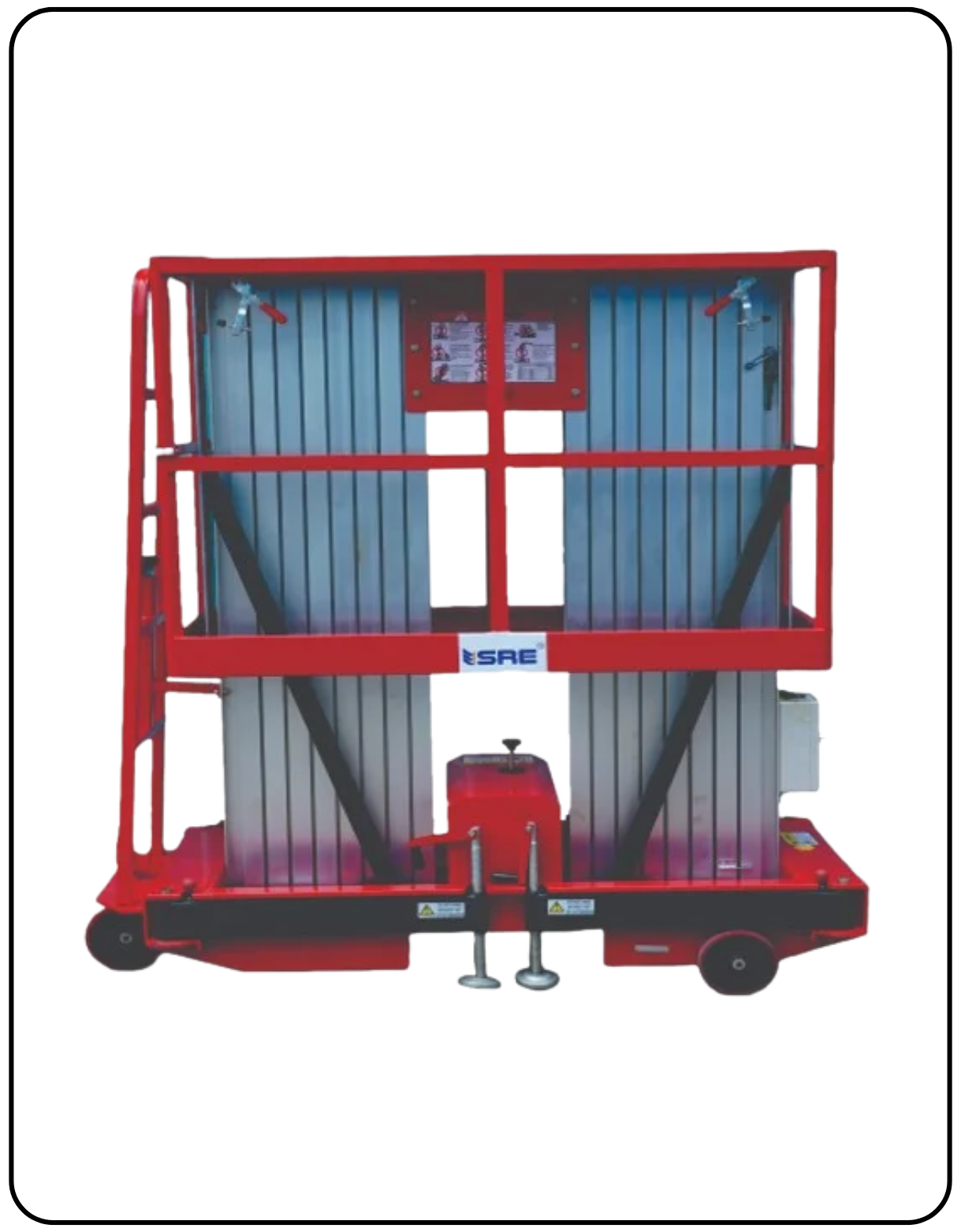
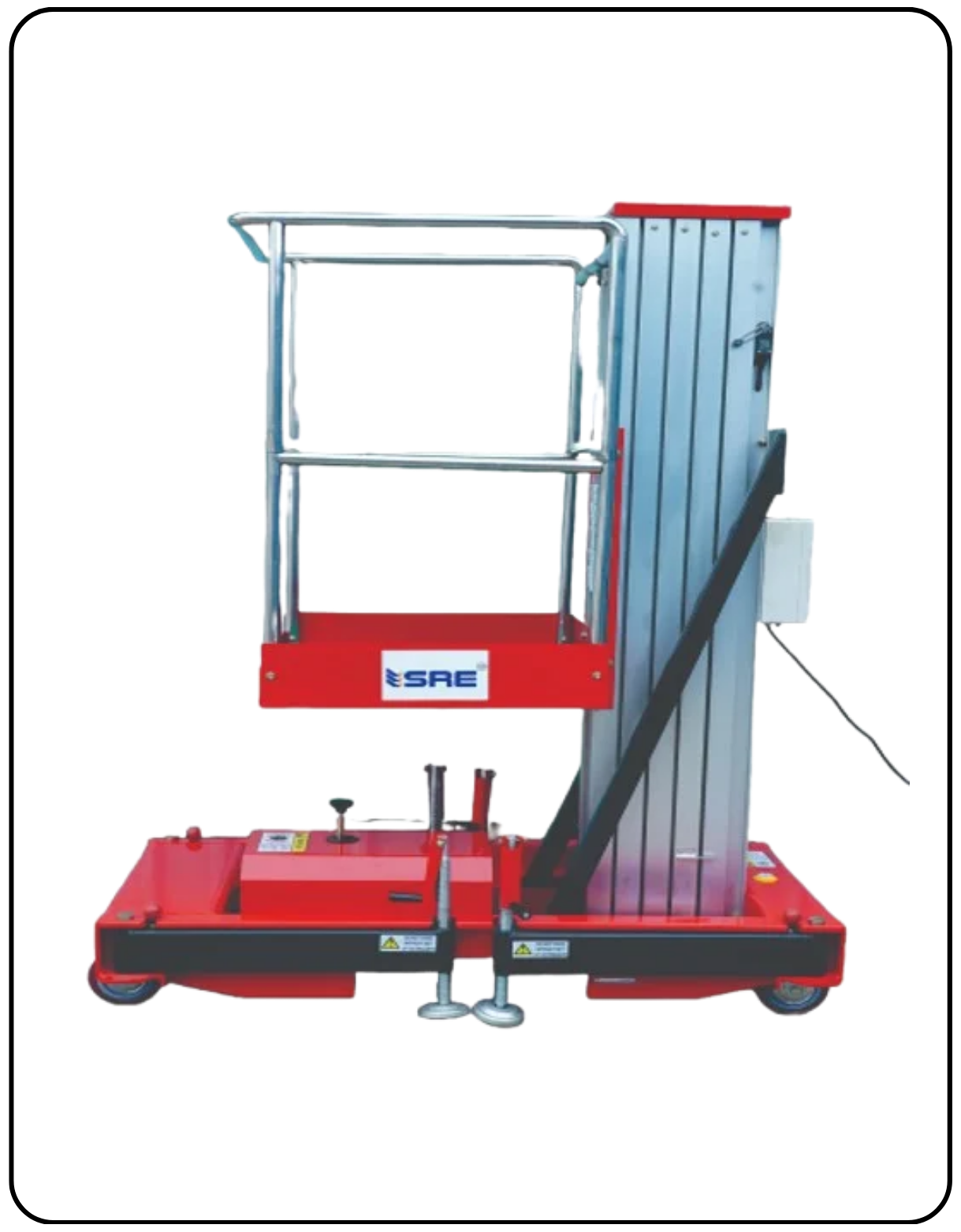
Product Description: SRE Aerial Work Platform (Model Variants)
SRE Material Handling Equipment Private Limited manufactures Aerial Work Platforms built specifically for industrial and warehouse environments. Available in the following standard configurations:
- ▸ 250 kg Capacity | 10-Metre Working Height Designed for heavy-duty access tasks in warehouses and assembly areas where both load capacity and height demand are high. Suitable for overhead equipment maintenance, racking installation, and material stacking at upper bay levels.
- ▸ 200 kg Capacity | 12-Metre Working Height A mid-range configuration suited for facilities with taller ceilings and regular maintenance or installation work. Balances reach and load capacity for general industrial applications.
- ▸ 150 kg Capacity | 14-Metre Working Height Ideal for high-clearance facilities such as large manufacturing plants, aircraft hangars, or high-bay distribution centres. Offers maximum reach with a controlled working load.
- ▸ Customised Configurations For facilities with non-standard floor plans, restricted aisle widths, or specific height and load requirements, SRE offers engineered-to-order solutions. Dimensions, power systems, guardrail specifications, and control mechanisms can be adapted to your facility’s actual needs.
All variants are built with structural stability as the primary design criterion: not just rated capacity on paper, but real-world performance under daily operating conditions.
Technology & Operational Efficiency
Battery-Operated Systems: Suited for multi-shift operations where the platform is in continuous use. Onboard battery systems offer consistent lift performance without operator effort. Charging infrastructure is simple, and most units maintain full shift capacity on a single charge cycle.
Hydraulic Manual Systems: Well-suited for lower-frequency access tasks where power infrastructure is limited or where operational simplicity is a priority. These units require minimal maintenance and have fewer components that can fail.
Both configurations prioritize uptime. In an industrial environment, a piece of equipment that’s out of service is a direct cost. SRE platforms are designed to reduce unplanned downtime through robust component selection, accessible maintenance points, and straightforward mechanical design.
Cost Efficiency Over Time
The real financial case for an Aerial Work Platform is rarely made on the purchase price alone: it’s made across the operational life of the equipment.
A properly specified AWP eliminates most of these. It reduces the physical demand on workers, decreases task time, and removes the dependency on scaffolding contractors for routine jobs. For procurement teams evaluating capital expenditure, the calculation is straightforward once indirect costs are factored in.
Key Features: SRE Aerial Work Platform
- Rated Load Capacities: 150 kg, 200 kg, and 250 kg standard variants
- Working Heights: 10 m, 12 m, and 14 m standard configurations
- Platform Guardrails: Full-perimeter fall protection built to safety standards
- Drive System Options: Battery-electric and manual hydraulic
- Compact Base Footprint: Designed for standard industrial aisle widths
- Non-Marking Wheels: Suitable for finished floor surfaces
Applications of Aerial Work Platforms
In Warehouses:
- High-bay racking access and inventory retrieval
- Bin label replacement and barcode scanning at upper levels
- Sprinkler and fire suppression system inspection
- Overhead lighting installation and replacement
In Manufacturing Facilities:
- Machinery and conveyor maintenance at elevation
- Overhead crane rail inspection
- Ventilation duct servicing
- Installation of structural components during plant expansion
In Commercial and Infrastructure Projects:
- False ceiling installation
- HVAC system servicing
- Electrical conduit routing
- Building façade and internal maintenance
In Specialised Environments:
- Aircraft hangar servicing
- Cold storage and temperature-controlled warehouse operations
- High-bay automotive assembly plants
Training, Ease of Use & Maintenance
One concern operations managers often raise is the learning curve associated with powered access equipment. In practice, an Aerial Work Platform of this type has a short onboarding period. Most workers with basic industrial equipment exposure are operational within a single training session.
Maintenance schedules are predictable. Battery systems require periodic charging checks and cell condition monitoring. Hydraulic systems require fluid level maintenance and seal
inspection at defined intervals. Neither is complex, and both can be managed by in-house maintenance teams without specialised contractor involvement.
Why Choosing a Reliable Aerial Work Platform Manufacturer Matters
When evaluating Aerial Work Platform suppliers, the product specification is only part of the decision. The manufacturer’s experience with industrial environments, their ability to provide after-sales service, and their willingness to support custom requirements matter equally: particularly for operations that run multiple shifts.
SRE Material Handling Equipment Private Limited brings that understanding to every build. With a focus on industrial-grade construction and responsive service support, SRE platforms are designed to work reliably in environments where equipment failure carries real operational and safety consequences.
Conclusion
For warehouse owners, factory managers, and operations leaders dealing with regular height-access requirements, an Aerial Work Platform is one of the most practical investments available. It addresses safety, reduces task time, lowers long-term indirect costs, and gives workers a stable, consistent way to do their jobs at elevation.
Reach out to SRE Material Handling Equipment Private Limited to discuss your facility’s specific requirements: height, load, aisle width, usage frequency: and get a configuration that’s built to work in your environment.
Key Takeaways
- Productivity: AWPs reduce task time significantly compared to ladders and fixed scaffolding: workers can access multiple locations in a single shift without repositioning delays
- Safety: Full-perimeter guardrails and rated load capacities reduce fall risk and tool drop incidents in compliance with industrial safety standards
- Load Handling: Available in 150 kg, 200 kg, and 250 kg configurations: workers can carry tools and materials to working height without separate handling
- Cost Efficiency: Long-term savings come from reduced incidents, lower contractor dependency, and fewer compliance-related costs: not just the equipment price
- Industry Trend: Facilities across warehousing, manufacturing, and logistics are moving away from fixed-height and manual access solutions toward mobile powered access equipment as operational safety standards rise
Frequently Asked Questions (FAQs)
Q1: What is the difference between a scissor lift and an Aerial Work Platform?
- A scissor lift is one type of AWP, typically with a larger deck and horizontal scissor mechanism. The term “Aerial Work Platform” refers to the broader category of personnel lifting equipment, which includes scissor lifts, vertical mast lifts, and boom lifts.
Q2: Is a battery-operated AWP suitable for indoor warehouse use?
- Yes. Battery-operated units produce zero direct emissions, making them well-suited for enclosed warehouse and factory environments.
Q3: What maintenance does an AWP typically require?
- Routine maintenance includes battery or hydraulic system checks, guardrail and wheel lock inspection, and periodic structural checks. Most maintenance can be handled by an in-house team following a standard schedule.
Q4: How long does operator training take?
- Most operators with basic industrial equipment experience can complete initial training in a single session. SRE Material Handling Equipment Private Limited provides operational guidance and hands-on demonstration as part of the product handover process.
Q5: Are SRE platforms compliant with Indian industrial safety standards?
#AerialWorkPlatform #AWP #MaterialHandling #WarehouseSafety #IndustrialEquipment #WorkingAtHeight #SREMaterialHandling #ElevatedWorkPlatform #WarehouseOperations #FactorySafety #HeightAccessEquipment #ScissorLift #MadeInIndia #IndustrialSafety #PlatformLift