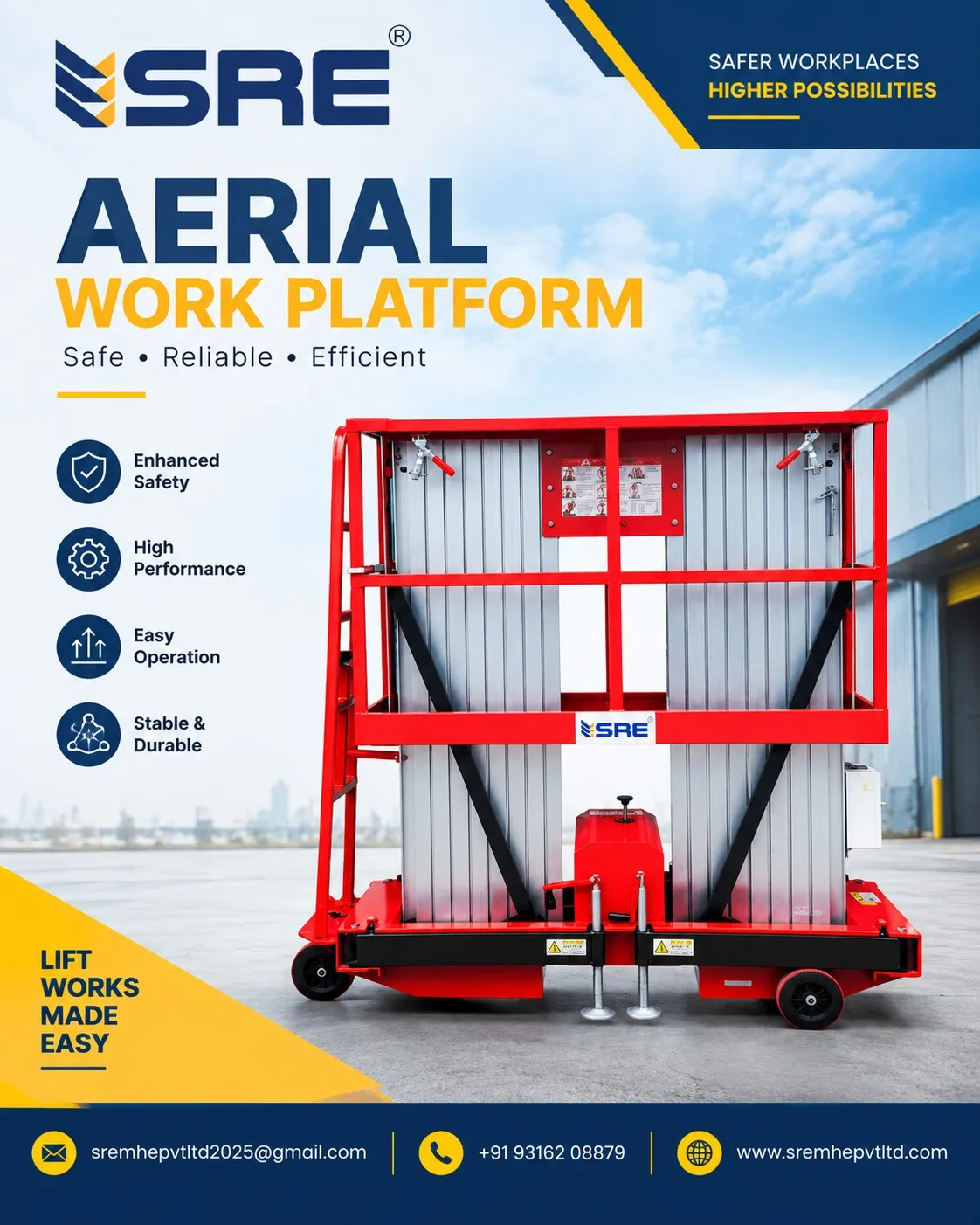
An aerial work platform lifts workers and tools to safe working heights, so tasks like maintenance, installation, and inspection no longer depend on risky ladders or scaffolding. The right machine protects your team, speeds up work, and keeps projects on schedule.
This guide explains how aerial work platforms function, the main types available, the safety features to check before buying, and how to match a machine to your job. It also shows why many Indian businesses trust SRE Material Handling Equipment for dependable lifting solutions.
What Is an Aerial Work Platform?
An aerial work platform (AWP) is a lifting machine with a platform, often called a basket, that rises to a set height. The operator controls movement directly from the platform, which provides a flat and stable working surface. Electricians, engineers, and maintenance teams use these machines to reach ceiling fixtures, overhead pipelines, cable trays, and high warehouse racks.
Compared with ladders, an aerial work platform carries more weight, keeps workers in one fixed position, and reduces the number of climbs that cause falls. Compared with scaffolding, it takes far less time to set up and moves easily from one location to another.
Main Types of Aerial Work Platforms
Choosing the right type starts with understanding how each design works.
Scissor Lifts
Scissor lifts raise the platform straight up using crossed metal supports. They offer a wide working deck and suit flat surfaces in factories, showrooms, and warehouses. An electric scissor lift produces no exhaust fumes, which makes it a practical choice for indoor work.
Boom Lifts
Boom lifts use an arm that extends up and outward. They reach over machinery, beams, and other obstacles, and they work well at greater heights. Articulating booms bend around equipment, while telescopic booms extend in a straight line.
Mast Platforms
Mast platforms use a vertical column with a compact platform. They pass through narrow doorways and fit into tight spaces such as stores, plant rooms, and small industrial units.
Self-Propelled Units
A self-propelled aerial work platform drives itself across the site, so the operator does not need a separate vehicle to move it. This feature saves significant time on large projects.
Contact UsKey Safety Features to Check Before Buying
Safety should guide every purchase decision. Reliable manufacturers build the following features into their machines, and buyers should verify each one before signing a purchase order.
Guardrails form a physical barrier around the platform, so workers stay inside during operation. Strong guardrails with toe boards also prevent tools and materials from falling onto people below.
Emergency stop buttons allow operators to halt all movement instantly. Good models place these controls on both the platform and the ground control panel, so a supervisor can stop the machine from the floor.
Overload protection sensors detect excess weight and block lifting until the load falls within the rated capacity. Staying within that capacity protects the machine’s structure and the safety of the operator.
Tilt sensors warn the operator when the platform leans beyond a safe angle and stop further movement. This feature matters most on uneven ground, where a small slope can quickly become a tipping hazard.
Stable outriggers or stabilizers add grip on uneven floors, and anti-slip platform surfaces reduce the risk of slipping during work.
Finally, check that the equipment meets recognized safety standards. The Occupational Safety and Health Administration (OSHA) publishes detailed guidance on aerial lift safety, and buyers can use it as a reference when reviewing any machine’s operating requirements.
How to Match the Right Platform to Your Job
Start with four questions. First, how high must workers reach? Platform height should exceed the working height by a safe margin. Second, how much weight will the platform carry? Include the worker, tools, and materials in your calculation. Third, where will the machine operate? Indoor floors call for electric models, while rough outdoor terrain may need a diesel or heavier-duty unit. Fourth, how often will the machine move? Frequent repositioning favours self-propelled or mobile designs.
Answering these questions before you buy prevents two common mistakes: choosing a machine that is too small for the job and paying for features you will never use.
Common Uses of Aerial Work Platforms in India
Aerial work platforms support a wide range of industries. Warehouses use them to service high racking and lighting. Factories rely on them for machine maintenance and overhead ducting. Construction crews use them for facade work, painting, and installation. Facility management teams depend on them for cleaning and repairs in large commercial buildings. Electrical contractors use them to reach substations and overhead lines safely.
Why Choose SRE Material Handling Equipment
SRE Material Handling Equipment Private Limited, formerly known as Shree Ram Enterprise, has served industrial clients since 2011. Founded by Mr. Gaurang Patel, the company operates from Vastral, Ahmedabad, and brings over ten years of hands-on experience in material handling.
The company has delivered more than 15,000 material handling solutions and maintains a client satisfaction rate of 95 percent. Its work has earned 13 industry awards, and it holds ISO 9001:2015 certification, which confirms its commitment to consistent quality management.
SRE offers a complete range of equipment, including precision-engineered pallet trucks, electric and hydraulic stackers, goods lifts, mobile floor cranes, scissor lifts, aerial work platforms, dock levellers, drum handling equipment, and custom material handling solutions for warehouses, factories, and logistics operations. The team designs each solution around the client’s load, height, and site conditions, so buyers receive equipment that fits their actual work rather than a generic model.
Conclusion
An aerial work platform turns risky height work into a controlled, efficient task. Scissor lifts, boom lifts, mast platforms, and self-propelled units each serve different jobs, so buyers should define their height, load, and site requirements first. Safety features such as guardrails, emergency stops, overload protection, and tilt sensors should never be optional.
Choose equipment from a manufacturer with proven experience and certified quality systems. SRE Material Handling Equipment combines engineering precision with 15,000-plus completed solutions to help businesses work safely at height. To discuss your requirements, call +91 9316 208879, email sremhepvtltd2025@gmail.com, or visit the office at Ground Floor, A-12, Pushp Business Campus, Ring Road Circle, Vastral, Ahmedabad 382418.
Frequently Asked Questions
Q. What is an aerial work platform used for?
- An aerial work platform lifts workers and tools to elevated areas for maintenance, installation, inspection, cleaning, and construction tasks. It provides a stable platform that is safer and more efficient than ladders.
Q. What is the difference between a scissor lift and a boom lift?
- A scissor lift raises the platform vertically and suits flat indoor or outdoor surfaces with a wide working deck. A boom lift extends an arm up and outward, so it reaches over obstacles and works at greater heights.
Q. Can electric aerial work platforms be used indoors?
- Yes. Electric aerial work platforms produce no exhaust fumes, so they suit indoor spaces such as warehouses, factories, and commercial buildings. Diesel models generally work better on rough outdoor terrain.
Q. What safety features should an aerial work platform have?
- A safe aerial work platform should include guardrails with toe boards, emergency stop controls on the platform and at ground level, overload protection, tilt sensors, and stabilizers or anti-slip surfaces. Verify that the machine meets recognized safety standards.
Q. How do I choose the right aerial work platform for my warehouse?
- Determine the maximum working height, the total load including workers and tools, and the floor condition. Indoor warehouses usually need an electric scissor lift or a mast platform, while large sites with frequent moves benefit from a self-propelled unit.
Q. Does SRE Material Handling Equipment manufacture aerial work platforms in India?
- Yes. SRE Material Handling Equipment offers aerial work platforms as part of its wider range of material handling equipment. The company, based in Vastral, Ahmedabad, has served industrial clients since 2011 and holds ISO 9001:2015 certification.