
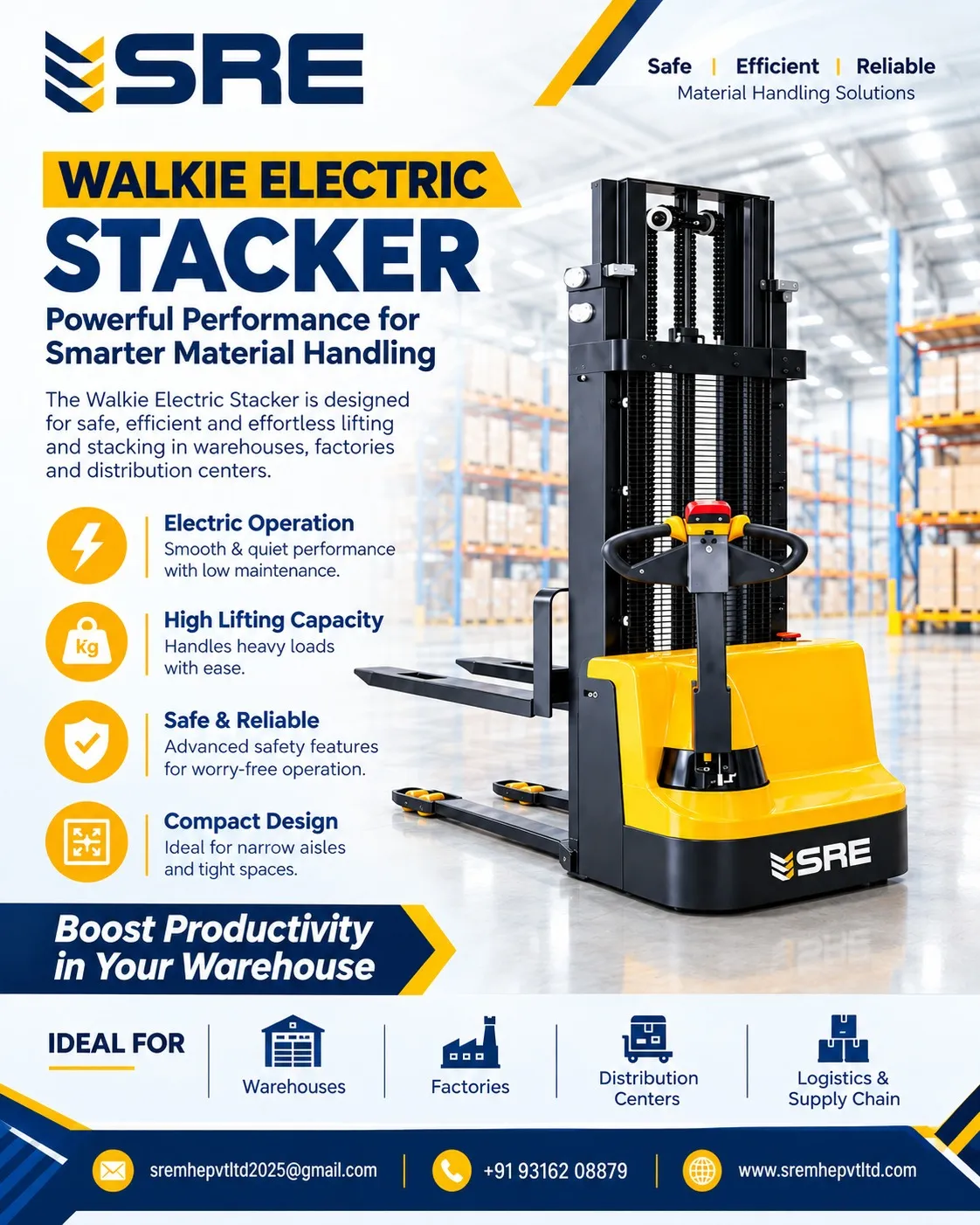
A walkie electric stacker is the simplest way to lift, move and stack pallets in a warehouse without a forklift. It runs on a battery, the operator walks behind it, and it fits into narrow aisles where larger machines cannot go.
If you manage a warehouse, factory or supermarket in India, this guide will help you pick the right model. You will learn how it works, which type suits your site, what specifications matter, and how to keep your operators safe.
At SRE Material Handling Equipment Private Limited, we have helped businesses across Gujarat and India choose and run stackers since 2011. This guide shares what we have learned from more than 15,000 delivered solutions.
What Is a Walkie Electric Stacker?
A walkie electric stacker is a pedestrian-operated lifting machine. Two forks slide under a pallet. An electric motor and hydraulic pump then raise the load to a rack or stack.
The word “walkie” means the operator walks behind or beside the machine. There is no seat and no cabin. The operator steers with a tiller handle and controls lifting with simple buttons.
It sits between a hand pallet truck and a full forklift. You get powered lifting at a much lower price and with a much smaller footprint.
How Does a Walkie Electric Stacker Work?
The machine has four main parts:
- Battery: Powers the drive and the lift motor. Most units use a rechargeable lead-acid or lithium battery.
- Mast: The vertical frame that guides the forks up and down.
- Forks: Carry the pallet. Fork length and width must match your pallet size.
- Tiller handle: Steers the machine and holds the lift, lower and travel controls.
When the operator presses the lift button, the motor drives a hydraulic pump. Oil pushes the cylinder up, and the forks rise with the load. A release valve lowers the forks smoothly.
Key Benefits of a Walkie Electric Stacker
- Less physical strain. Operators stop pumping and pushing heavy loads by hand.
- Faster pallet handling. Powered travel and lifting cut cycle time.
- Tight-aisle ability. The small turning radius suits narrow racking.
- Lower cost. The purchase price and running cost are well below a forklift.
- Quiet and clean. There are no exhaust fumes, which suits food, pharma and retail.
- Easy training. Most operators learn the basics in a single shift.
Types of Walkie Electric Stackers
Semi-Electric Walkie Stacker
The lift is powered, but the operator pushes and pulls the machine by hand. It is the most affordable option and works well for short moves and low usage.
Fully Electric Walkie Stacker
Both lifting and travel are powered. It suits longer distances, heavier loads and frequent use across a shift.
Straddle Leg Stacker
Two legs straddle the pallet. It handles standard pallets and is common in general warehouses.
Reach Stacker
The forks extend forward from the mast. It stores loads deeper in racks and works in very narrow aisles.
Counterbalance Walkie Stacker
A counterweight at the rear balances the load, so no straddle legs are needed. It can lift loads onto platforms and trucks.
Contact UsWalkie Electric Stacker Specifications to Check
Always compare these specifications before you buy:
| Specification | Why it matters | Typical range |
|---|---|---|
| Rated capacity | Maximum safe load | 1,000 kg to 2,000 kg |
| Lift height | Highest rack level you can reach | About 1.6 m to over 5 m |
| Fork length | Must support the full pallet | 1,000 mm to 1,200 mm |
| Load centre | Distance from fork heel to load centre | Commonly 500 mm to 600 mm |
| Turning radius | Decides aisle width needed | Smaller is better for tight aisles |
| Battery type | Affects run time and upkeep | Lead-acid or lithium |
| Travel speed | Impacts throughput | Walking pace, with a safety limit |
Capacity drops as lift height rises. Ask for the load chart of the exact model, not just the headline capacity. Our team at SRE can share it before you order.
Where Is a Walkie Electric Stacker Used?
- Warehouses and distribution centres: put-away, retrieval and loading.
- Factories: moving raw material and finished goods between lines.
- Supermarkets and retail stores: restocking high shelves from the back room.
- Cold storage and food units: clean, fume-free handling.
- Pharma and chemical units: controlled, careful pallet movement.
- Logistics and 3PL yards: quick loading of small to medium consignments.
Walkie Electric Stacker vs Manual Stacker vs Forklift
| Feature | Manual stacker | Walkie electric stacker | Forklift |
|---|---|---|---|
| Lifting | Hand pump | Electric | Electric, diesel or LPG |
| Operator effort | High | Low | Low |
| Aisle space needed | Small | Small | Large |
| Purchase cost | Lowest | Moderate | Highest |
| Best for | Occasional use | Daily small to medium loads | Heavy, high-volume work |
Choose a walkie electric stacker when you move pallets daily, your aisles are narrow, and your loads stay under about two tonnes.
How to Choose the Right Walkie Electric Stacker
Follow these steps:
- Weigh your heaviest pallet. Add a safety margin of at least 20%.
- Measure your highest rack level. Pick a lift height that clears it with room to spare.
- Check pallet size. Match fork length and width to your pallets.
- Measure your aisles. Compare them to the turning radius and the machine’s length.
- Estimate daily use. Heavy shift work needs a fully electric model with a strong battery.
- Look at the floor. Smooth concrete suits standard wheels. Uneven floors need better wheels or a different model.
- Plan for service. Pick a supplier with spares and technicians nearby.
Safety Tips for Operators
Powered stackers are safe when used properly. Follow the principles in OSHA’s guidance on powered industrial trucks and train every operator.
- Never exceed the rated capacity.
- Keep forks low while travelling.
- Walk behind the machine and keep your feet clear of the wheels.
- Lift only stable, well-stacked pallets.
- Do not carry passengers or stand under raised forks.
- Use the emergency stop if anything feels wrong.
- Charge batteries in a ventilated area.
Maintenance Checklist
Daily: check the battery charge, wheels, forks, horn and brakes.
Weekly: inspect the hydraulic hoses for leaks and clean the mast channels.
Monthly: check the oil level, tighten fasteners and test the emergency stop.
Yearly: book a full service from a qualified technician.
Good care extends battery life and prevents breakdowns that stall your dock.
Why Buy a Walkie Electric Stacker from SRE Material Handling Equipment
We are a trusted material handling partner in Ahmedabad, built on real results:
- Since 2011: over ten years of hands-on experience.
- 15K+ solutions delivered across warehouses, factories and logistics sites.
- 95% client satisfaction rate and 13 industry awards.
- ISO 9001-2015 certified for quality management. Read more about ISO 9001.
- Full range: pallet trucks, electric and hydraulic stackers, goods lifts, mobile floor cranes, scissor lifts, aerial work platforms, dock levelers and drum handling equipment.
- Custom solutions built around your layout and loads.
The company was founded by Mr. Gaurang Patel, and our engineers help you select the right model, not the most expensive one. Explore our full range on the SRE Material Handling Equipment.
Get a Quote for Your Walkie Electric Stacker
Tell us your load, lift height and pallet size. We will recommend a walkie electric stacker that fits your site and budget.
SRE Material Handling Equipment Private Limited Ground Floor, A-12, Pushp Business Campus, Ring Road Circle, Vastral, Ahmedabad – 382418, Gujarat, India Phone: +91 9316 208879 Email: sremhepvtltd2025@gmail.com
FAQs
Q.What is a walkie electric stacker used for?
- It lifts, moves and stacks pallets in warehouses, factories and stores. It is ideal for short distances, narrow aisles and low to mid-level racking.
Q.How much weight can a walkie electric stacker lift?
- Most models lift between 1,000 kg and 2,000 kg. The safe load falls as the forks rise, so always check the load chart.
Q.What is the difference between a walkie stacker and a forklift?
- A walkie stacker is operated on foot, is smaller and costs less. A forklift has a seat, handles heavier loads and needs wider aisles.
How long does the battery last?
- Run time depends on load, lift frequency and battery type. A typical battery serves one full shift on a single charge. Lithium batteries charge faster.
Do operators need a licence?
- Rules vary by site. Every operator should receive formal training before use, and your safety officer should confirm local requirements.
Can I get a custom walkie electric stacker?
- Yes. SRE builds custom fork sizes, lift heights and capacities for special applications.
Conclusion
A walkie electric stacker gives you powered lifting, tight-aisle handling and low running costs in one compact machine. Match the capacity, lift height and battery to your daily workload, train your operators, and service the machine on schedule.
Ready to upgrade your material handling? Call +91 9316 208879 or email sremhepvtltd2025@gmail.com to speak with the SRE Material Handling Equipment team today.
Contact Us